
Key takeaways:
How to make a basic table involves critical steps including precise measurements and proper joinery techniques such as dowels and screws. Standard table height ranges from 28 to 30 inches, essential for ergonomics and stability. Selecting materials like hardwoods or softwoods impacts durability and finish quality in woodworking projects.
Do you often struggle to find the right dimensions and materials when building furniture? Constructing a table requires attention to style and function, with exact table length, width, and height influencing comfort and usability. Understanding joinery options and wood types ensures lasting strength and an attractive finish. Mastering these core woodworking details will allow you to confidently create well-proportioned tables with professional-level craftsmanship and reliable durability.
How to Make a Basic Table: Step-by-Step Guide
Building a basic table starts with a clear plan and follows through with proper execution of each step. This guide will teach you how to make a basic table by breaking down the process into easy-to-follow stages, from planning to finishing.
Start by deciding the purpose of your table—whether it will be a dining table, workbench, or side table—as this affects dimensions and materials.
- Gather your materials and tools
- Measure and cut precisely
- Join the parts securely
- Finish with sanding and sealing
Planning Your Table: Size, Style, and Use
The first crucial phase in how to make a basic table is planning your table’s size and style. Most standard dining tables have a height between 28 and 30 inches, which is comfortable for sitting and working.
The aprons that connect the legs are typically around 3 to 4 inches wide, giving the table enough rigidity without compromising leg space. Think carefully about the style: simple rectangular tops, round tops, or even tapered legs can change the table’s look and feel.
Consider where the table will be placed and its main use to determine the best proportions and details.
Material Selection and Cutting: Beams, Boards, and Tools
Choosing Beams and Boards
Selecting the right wood is essential for a sturdy and attractive table. Common choices include hardwoods like oak or maple for durability, or softwoods such as pine for affordability and ease of work.
Quality beams for legs should be straight and free from cracks. For the tabletop, thicker boards provide stability and reduce warping. Using beams with consistent grain and moisture levels helps achieve smoother joints.
Cut List and Measurements
A precise cut list avoids waste and prevents mistakes. Here is an example for a basic rectangular table:
- Tabletop: 60 inches long × 30 inches wide × 1 inch thick
- Legs: 28 to 30 inches long (depending on final height)
- Apron pieces: 3 to 4 inches wide × length equal to tabletop sides minus leg thickness
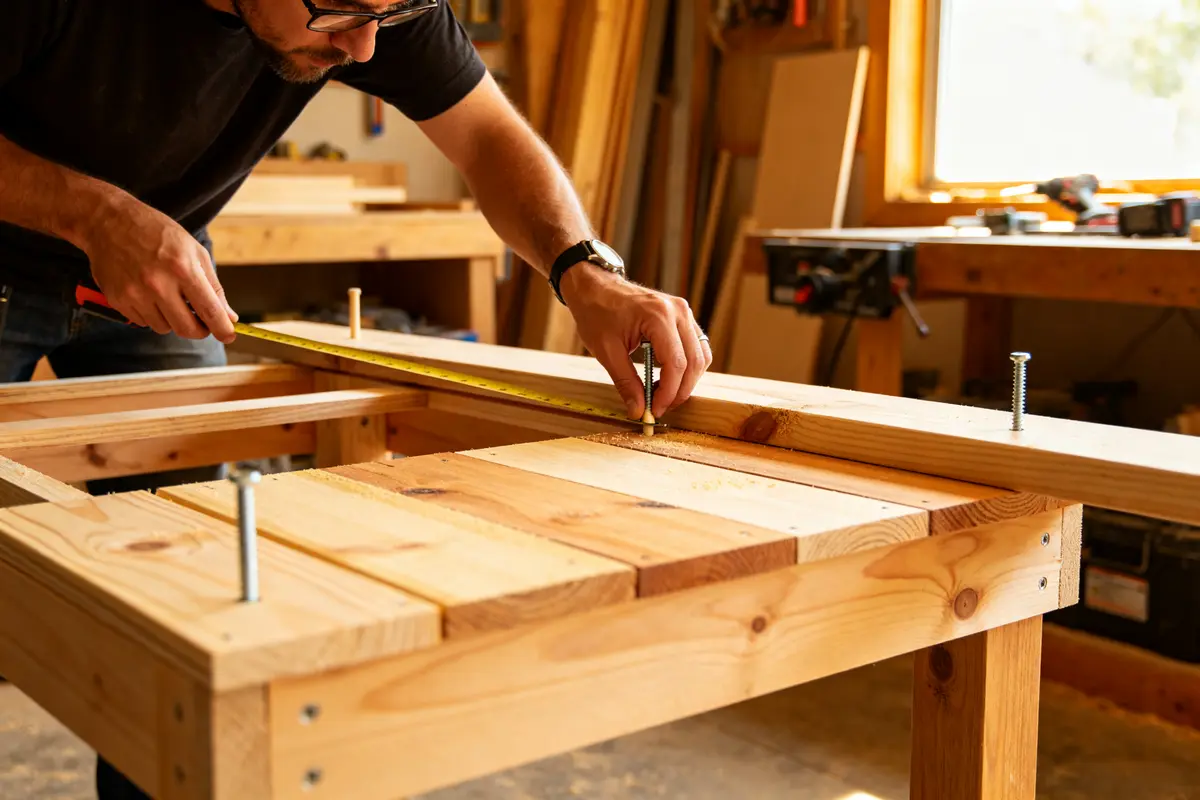
Including the standard table height in your measurements ensures ergonomic comfort. Measure twice to confirm dimensions before cutting to avoid errors that might affect assembly and alignment.
Tools for Cutting and Shaping
To work effectively, you’ll need reliable tools. A circular saw or miter saw is best for straight, accurate cuts. Hand saws can also be used if power tools aren’t available but require patience and precision.
A chop saw or table saw is useful for larger projects and repeated cuts. For shaping edges, a router or sanding blocks help create smooth, finished surfaces.
Joinery and Assembly: Dowels, Screws, and Fasteners
Dowels vs Screws: Which to Use
Choosing between dowels and screws for joinery depends on your priorities. Dowels provide a cleaner, more aesthetic finish with hidden joints and good load capacity. They require precise drilling and careful alignment.
Screws offer easier assembly and strength, plus the potential for disassembly later, which is handy for DIYers who want to adjust or move their table. However, screws may be visible unless countersunk and plugged.
Alignment and Holes: Sizing and Spacing
Proper alignment ensures your table is solid and level. Use a doweling jig or template to drill holes that match perfectly on joining pieces. Space holes evenly, commonly 1 inch from the edges and 6 to 8 inches apart depending on apron length. Hole depth should be about half the dowel length.
If using screws, predrill pilot holes to prevent wood splitting and countersink holes for the screw heads to sit flush with the surface.
Tightening, Clamping, and Dry Fit
Before final glue-up, always perform a dry fit to check how parts align and fit together. Adjust as necessary to ensure tight joints and a squared frame.
When gluing dowels, apply wood glue liberally in the holes and on the dowels. Use clamps to hold parts firmly in place while drying, typically 30 minutes to an hour for initial set, and up to 24 hours for full strength. Tightening screws steadily avoids sudden pressure that could crack the wood.
Author’s Note
“Accurate hole alignment and consistent clamping pressure are key to a table that stands firm and looks professional.”
Finishing and Maintenance: Sanding and Oil
Finishing your table gives it that polished, lasting appeal. Start sanding with 120 grit paper, then progress through 240, 400, and up to 600 or 800 grits for an ultra-smooth tabletop ready for finishing.
Clean thoroughly between sanding steps by vacuuming or wiping with a damp cloth. This removes dust particles that can cause scratches.
Apply a fine quality oil, such as tung or Danish oil, to seal and enhance the wood grain. Rub in the oil with a clean cloth, allowing it to soak into the end grain more deeply, then wipe off the excess after 15 minutes to avoid sticky surfaces. Multiple coats, with light sanding between, produce a durable, easy-to-maintain finish.
How to Make a Basic Table: Troubleshooting and Pitfalls
Common issues include uneven legs, misaligned joinery, and warping tops. Avoid these by taking careful measurements and performing dry fits.
If legs wobble, check for levelness and sand or plane as needed. For bowing or twisting table tops, consider spreading weight evenly and securing the aprons tightly.
Using the wrong fasteners or insufficient glue can lead to weak joints. Dowels require precise hole sizing or they won’t hold; screws need proper pilot holes to prevent splitting.
Lastly, impatient clamping or rushing the finish can cause glue joints to fail or finish coats to bubble—allow full drying times for best results.
🧮 Table Dimension Calculator
Quickly estimate your material cuts and tabletop size based on desired table dimensions.
FAQ: how to make a basic table
How to make a table step by step?
Making a table step by step involves planning size and style, selecting materials, cutting wood precisely, joining parts securely using dowels or screws, and finishing with sanding and sealing. Accurate measurements and clamps ensure a stable, professional result.
How to create a table easily?
To create a table easily, start with a simple design, use common tools like a circular saw, and choose screws for faster assembly. Measuring twice, dry fitting parts, and sanding before finishing help simplify the process and improve quality.
How to set up a simple table?
Setting up a simple table requires assembling pre-cut legs and aprons onto the tabletop. Use screws or dowels to join components, ensure alignment with clamps, and secure joints tightly. Finish by sanding and applying oil for durability.
What is the cheapest material to make a table out of?
The cheapest material to make a table out of is softwood, such as pine. It is affordable, easier to work with, and widely available, though less durable than hardwoods like oak or maple.

Damian is an inquisitive writer with a passion for exploring diverse subjects. He loves sharing fresh perspectives, inspiring curiosity, and sparking meaningful conversations. For him, every topic is an opportunity to learn, connect, and uncover new ideas.