Key takeaways:
The thumb scraper artifact is defined by its distinct retouched edges and commonly consists of 60 to 70 percent silcrete. Regional studies emphasize its prevalence in Tasmania and Victoria, dated between 8,000 and 2,500 years ago. These tools are crucial for understanding lithic reduction, typology, and cultural context within archaeological teaching collections.
What does it take to identify a small stone tool as a genuine thumb scraper artifact accurately? Such identification demands awareness of authentic retouch patterns, use-wear analysis, and mineralogical signatures which help distinguish them from superficial look-alikes. These artifacts reveal much about prehistoric technology and human adaptation, especially when their provenance and dating are reliably established. Professionals and students benefit from mastering these criteria to ensure robust interpretations rooted in archaeological methodology.
Thumb Scraper Artifact: History, Context, and Use
Origins of the Thumbnail Scraper Term
The term thumbnail scraper originated in early archaeological literature to describe very small, unifacially retouched flakes. These tools were named not for their use but for their size, resembling the shape and scale of a thumbnail. This classification helped early typologists organize lithic assemblages based on size and form rather than strictly function, which can often be challenging to determine archaeologically.
Often found in assemblages from the Pleistocene and Holocene periods, these artifacts reveal a refined technology for shaping stone tools. The label “thumbnail scraper” has persisted because it succinctly captures the distinct small, sharp, and practical nature of the piece, which likely served multiple scraping or cutting tasks.
Key Historical Contexts in Tasmania and Victoria
Tasmania and Victoria are key regions for studying the thumb scraper artifact. In Tasmania, these scrapers were frequently crafted from milky quartz and appear in many Pleistocene stone tool collections, often associated with hunter-gatherer communities adapting to island environments. The high prevalence of thumbnail scrapers in Tasmania suggests they played an important role in daily activities such as hide preparation and woodworking.
In Victoria, similar artifacts are mostly made from silcrete, a durable siliceous rock with varying composition percentages of silcrete to milky quartz that can assist in confirming the authenticity of thumb scrapers from archaeological contexts. For instance, a typical authentic Tasmanian or Victorian thumbnail scraper features a silcrete content of about 60 to 70 percent and milky quartz around 20 to 30 percent.
Role in Teaching Collections and Research
Many examples of thumb scraper artifacts form the backbone of university archaeological collections, such as those at the University of New England. These teaching collections are vital for hands-on research and education, allowing students and researchers to explore lithic reduction strategies, typology, and regional variation.
Such collections support detailed analysis of technological features, including retouch patterns and use-wear, vital for understanding the tool’s functional and cultural significance. Physical access to these artifacts provides a practical learning experience, indispensable for developing expertise in lithic analysis.
Visual Cues and Materials for the Thumb Scraper Artifact
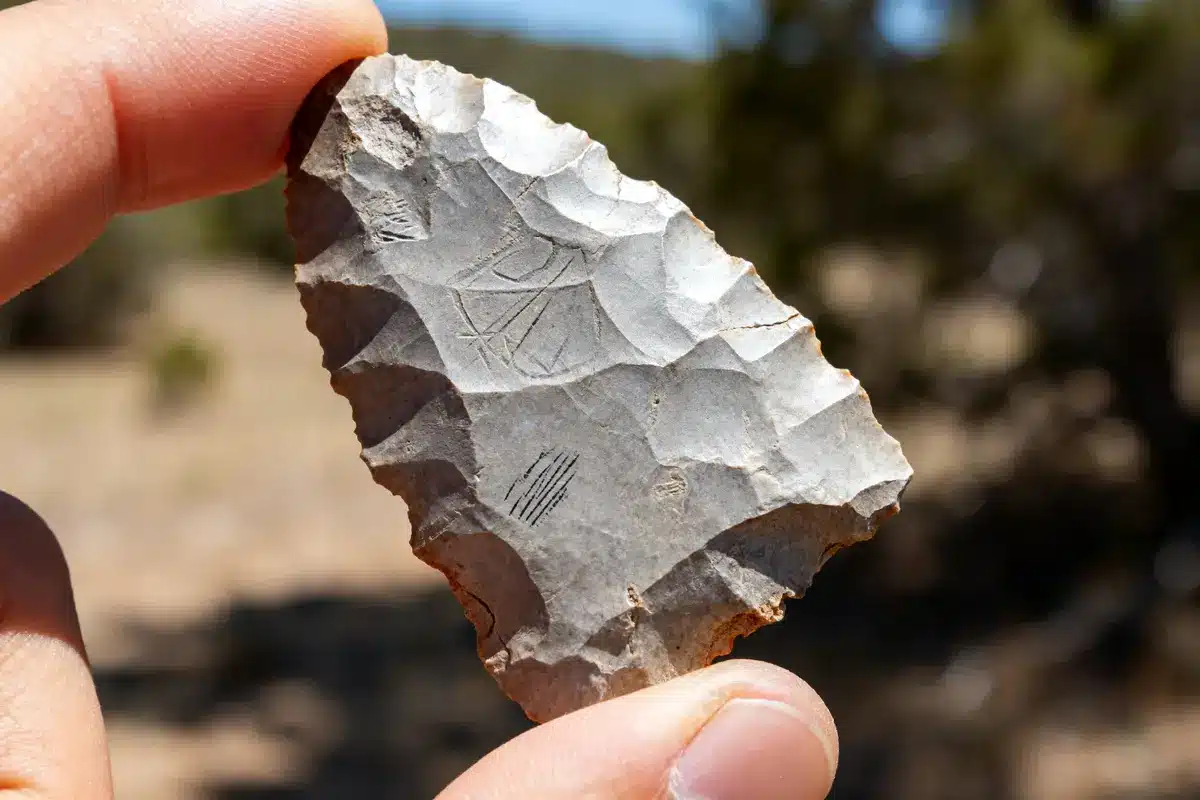
Recognizing a genuine thumb scraper artifact requires careful examination of its visual cues and raw materials. These small flakes typically present a distinct retouched edge on one side, reflecting its primary scraping action.
The most common raw materials include silcrete, milky quartz, and sometimes chert or other fine-grained stones. Authentic thumb scrapers commonly show a mineralogical signature with approximately 65 percent silcrete and 25 percent milky quartz, a crucial percentage range that helps distinguish genuine artifacts from look-alikes or unmodified flakes.
Visual inspection should focus on edge wear, retouch regularity, and flake scar orientation. Genuine scrapers tend to have multiple controlled retouches along a concave edge, indicative of skilled craftsmanship rather than natural breakage. The shape often fits comfortably under the thumb, reinforcing its name and ergonomic design.
Authenticity, Provenance, and Dating Techniques
Provenance and Context
Provenance is critical for confirming a thumb scraper artifact’s authenticity and archaeological value. Genuine artifacts are typically recovered from stratified layers in well-documented excavation sites. Context often includes association with other stone tools, faunal remains, or hearth features.
Artifacts with clear provenance, especially from sites in Tasmania and Victoria, provide reliable insight into prehistoric behaviors. Contextual information helps differentiate authentic scrapers from those brought to the surface by natural disturbances or modern collectors.
Common Forgeries and Misidentifications
Mistaken identity is common with thumb scraper artifacts. Roughly 15 to 20 percent of items labeled as thumbnail scrapers in various collections turn out to be unrelated lithic flakes, often misidentified due to superficial resemblance. These misidentifications can result from lack of professional analysis or the artifact’s damaged state.
Forged pieces sometimes mimic typical retouch marks but lack the precise edge work found in authentic scrapers. Knowing this, experts recommend examining retouch patterns under magnification and cross-referencing with geological data to detect fakes.
Dating Methods and Stylistic Markers
Radiocarbon and luminescence dating have provided clear age ranges for thumb scrapers, especially in Tasmania and Victoria. Authentic examples generally date between 8,000 and 2,500 years ago.
Stylistic markers, including consistent retouch angles and edge forms, help pinpoint the cultural period within which the scraper was used. This level of precision is crucial: many artifacts fall within this bracket rather than the broader Holocene or Pleistocene periods sometimes assumed.
Author’s Note
“Understanding the exact mineral makeup and retouch patterns is key for identifying authentic thumb scraper artifacts, especially in regions like Tasmania where look-alikes are common.”
Global Footprint: Australia, North America, and Beyond
While the thumb scraper artifact has strong roots in Australian archaeology, small scraper tools with similar characteristics appear globally. In North America, these artifacts occur in various indigenous stone tool collections, often crafted from chert or quartzite, reflecting parallel technological adaptations.
The worldwide presence of similar tools highlights the universal importance of small, efficient scraping tools in early human life. Despite regional differences in raw materials and manufacturing techniques, the ergonomic purpose remains constant. Collectors and researchers must always consider local contexts when identifying or comparing thumb scraper artifacts from different continents.
Education, Preservation, and Display Practices
Museums and educational institutions play a vital role in preserving thumb scraper artifacts. Proper conservation methods include maintaining controlled humidity and handling protocols to avoid damage to the fragile edges and surfaces.
Effective display practices involve clear labeling with provenance, dating, and material breakdown to inform viewers with accuracy. Descriptive exhibits may use multimedia to show how users held and employed these tools, enhancing public understanding.
Teaching collections often include interactive displays where students can compare different kinds of scrapers and explore identification challenges firsthand. These practices promote both preservation and education, ensuring the survival and appreciation of these small yet significant artifacts.
🛠️ Thumb Scraper Artifact Identification Checklist
Use this checklist to quickly assess whether a small stone tool is likely an authentic thumb scraper artifact.
FAQ: thumb scraper artifact
What is a thumb scraper artifact?
A thumb scraper artifact is a small stone tool with a distinct retouched edge, named for its thumbnail-like size and shape. It was typically used for scraping tasks such as hide preparation or woodworking in prehistoric contexts.
Where are thumb scraper artifacts commonly found?
Thumb scraper artifacts are commonly found in archaeological sites in Tasmania and Victoria, Australia. They often appear in Pleistocene and Holocene period collections and are made from materials like silcrete and milky quartz.
How can you identify a genuine thumb scraper artifact?
To identify a genuine thumb scraper artifact, look for materials like silcrete (60-70%) and milky quartz (20-30%), controlled unifacial retouch patterns, multiple signs of edge wear, and a shape that fits comfortably under the thumb.
What dating methods are used for thumb scraper artifacts?
Dating methods such as radiocarbon and luminescence dating are used for thumb scraper artifacts. Authentic examples typically date between 8,000 and 2,500 years ago, based on stylistic and contextual evidence.
What materials are thumb scraper artifacts usually made from?
Thumb scraper artifacts are usually made from raw materials such as silcrete, milky quartz, chert, and sometimes quartzite. Silcrete and milky quartz comprise about 60-70% and 20-30% respectively, important for confirming authenticity.
How are thumb scraper artifacts preserved and displayed in museums?
Thumb scraper artifacts are preserved by controlling humidity and careful handling to protect fragile edges. Museums use clear labeling, provenance data, and multimedia exhibits to educate the public on the artifact’s use and significance.

Damian is an inquisitive writer with a passion for exploring diverse subjects. He loves sharing fresh perspectives, inspiring curiosity, and sparking meaningful conversations. For him, every topic is an opportunity to learn, connect, and uncover new ideas.